
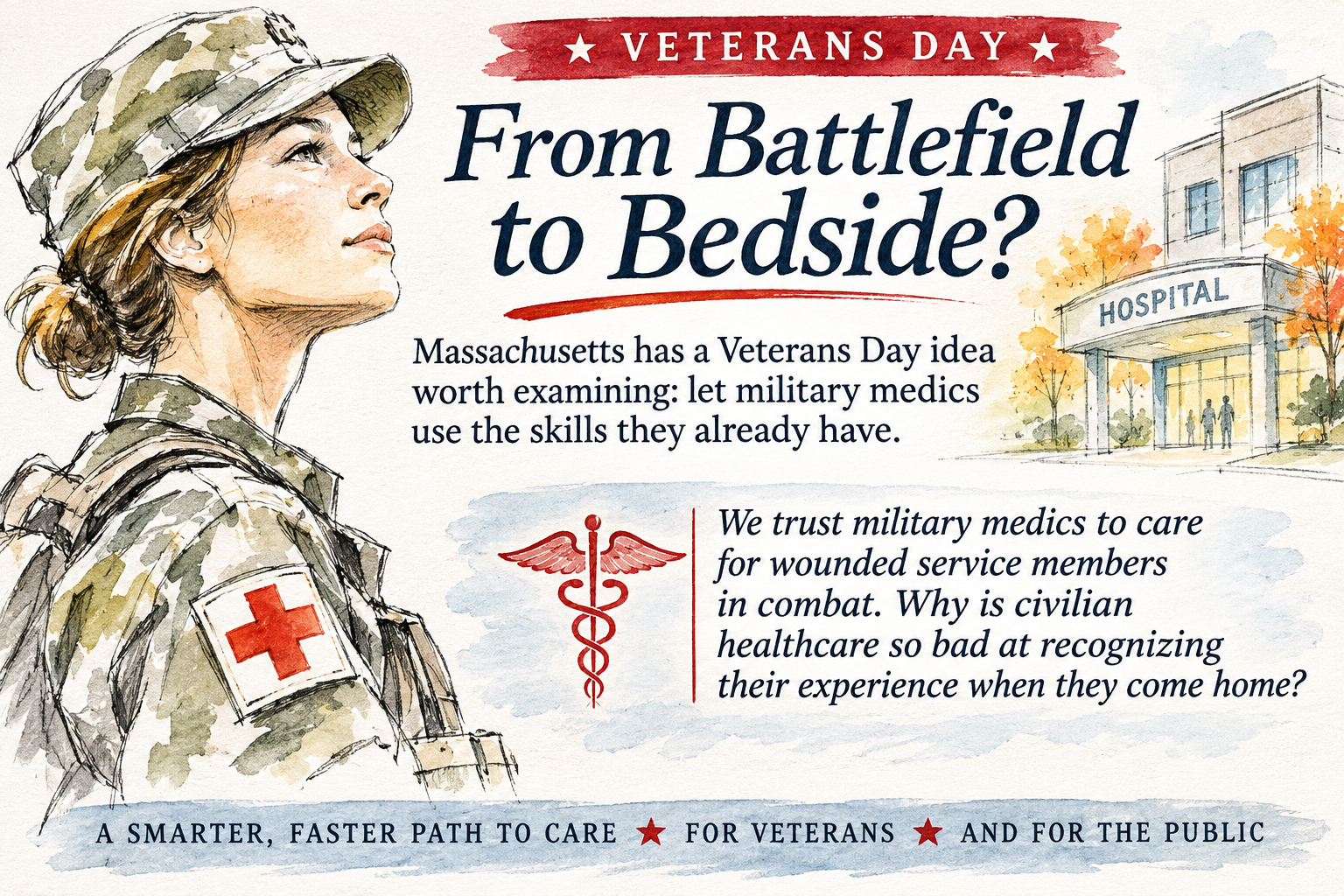
The Massachusetts military medic proposal exposes a larger problem: a healthcare system that doesn't always know how to recognize competence when it comes from outside its established pathways.
Health for Life: When the Healthcare System Refuses to Recognize What You Know
Massachusetts has proposed a small pilot program that raises one of the biggest questions we should be asking about American healthcare.
What makes someone qualified to care for another human being?
Is it education? A license? Years of experience? Demonstrated clinical competence?
Ideally, it's an appropriate combination of all four.
But our healthcare system often places enormous weight on where and how someone acquired a credential, while making it surprisingly difficult to recognize knowledge and experience acquired through other rigorous pathways.
A new Veterans Day announcement from Massachusetts illustrates the problem beautifully.
Skilled Enough for the Battlefield. Not Credentialed for the Hospital.
On November 10, 2026, Governor Maura Healey announced plans for a Military to Medicine pilot program.
The idea is to create opportunities for former military medics to use their clinical training and experience in Massachusetts hospitals.
The initial proposal is limited to ten veterans, who would be eligible to perform specified medication-administration activities in approved hospitals.
The initiative still requires regulatory approval.
Why is this necessary?
Because military medics and hospital corpsmen can acquire extensive medical training and practical clinical experience, yet find that much of that experience isn't readily recognized when they return to civilian life.
Someone who has treated serious injuries, provided emergency care, administered medications, and supported medical teams under extraordinarily difficult circumstances can face substantial barriers to performing comparable tasks in a civilian setting.
Different settings require different competencies, of course. Clinical responsibilities must be carefully evaluated, and specialized civilian practice may require additional preparation.
But the starting point should be an honest assessment of what an individual already knows and can safely do.
Why should the default assumption be that education and experience don't count unless they were acquired through the approved civilian pathway?
The Difference Between a Credential and Competence
I have worked in nursing for more than forty years, and I have enormous respect for professional education and clinical standards.
Licensing is important.
Patients deserve to know that the people treating them have appropriate knowledge, skills, ethical obligations, and accountability.
But we should also recognize the limitations of credentialing systems.
A license documents that someone has met established requirements for a particular profession. It doesn't establish that every licensed professional has identical abilities, experience, judgment, or effectiveness.
Nor does the absence of a particular civilian license mean a person has no relevant medical knowledge or clinical competence.
Consider the differences between an experienced military medic, a newly licensed registered nurse, a physician assistant, an emergency medical technician, and a physician.
Their education and authorized responsibilities differ. Their skills may overlap in some areas and diverge significantly in others.
The answer is not to pretend that these professions are interchangeable.
The answer is to build pathways that identify what people are already competent to do, what they still need to learn, and how they can safely advance.
That requires more imagination than simply rejecting an applicant because the credential doesn't fit the job description.
I've Seen the Other Side of This System
In my recent Health for Life article, The Health Work Nobody Pays For, I described a different but related contradiction.
Physicians came to me as patients. Even the CEO of a major hospital came to me.
I am a registered nurse and health coach with degrees in biopsychology and nursing. I have spent many years helping people understand their health, navigate complicated decisions, develop healthier habits, and make meaningful changes in their lives.
Many of the professionals who came to me possessed more formal medical education, higher institutional status, and greater financial resources.
Yet they sought something my particular combination of education, experience, and practical coaching skills could provide.
My work was private pay.
The usual healthcare financing system had little room to reimburse the ongoing education, behavioral support, and accountability that were central to what I offered.
Think about that.
We have a system capable of paying enormous sums for diagnosis, procedures, medications, and hospital treatment.
Yet the work that helps people understand their conditions, change behavior, and sustain improvements can remain difficult to fund or integrate into ordinary care.
This is not exactly the same problem facing military medics.
But there is a common thread.
Our healthcare institutions don't always recognize, integrate, or compensate useful clinical and health-related expertise according to the value it can contribute.
Often, the rules determining who may provide a service and how that service is paid for matter more than the system's ability to evaluate the full contribution a professional can make.
Who Benefits From the Way We Organize Healthcare?
That's a question worth asking.
Professional organizations, licensing boards, educational institutions, hospitals, insurers, and government regulators all influence the structure of our healthcare system.
Each has legitimate responsibilities.
Education matters. Clinical standards matter. Professional accountability matters. Patient safety is nonnegotiable.
But professional boundaries can also create institutional advantages.
Some establish necessary protections against unsafe practice. Others may become unnecessarily rigid, particularly when education, technology, and healthcare needs change faster than regulations.
Educational programs can require substantial time and money. Licensing pathways can limit entry to particular professions. Reimbursement rules can determine whether certain kinds of valuable care are economically sustainable.
These structures influence which careers are available, which services patients can access, and which professionals are able to earn a living.
It is reasonable to ask whether every barrier still serves the purpose for which it was established.
It is also reasonable to ask whether some barriers persist because changing them would require powerful institutions to reconsider how responsibilities, authority, and revenue are distributed.
We should be able to examine these questions without treating professional standards as untouchable.
A health system designed around patient outcomes should be willing to evaluate whether its own rules are helping or interfering with those outcomes.
Why Competency-Based Pathways Make Sense
Imagine an experienced military medic entering civilian healthcare through a carefully structured assessment process.
Instead of automatically repeating years of education, the veteran's training records, previous responsibilities, demonstrated skills, and clinical experience are evaluated.
Where competencies align with a particular civilian role, those skills are recognized.
Where meaningful differences exist, targeted education is provided.
Where supervision is appropriate, supervised clinical practice bridges the gap.
And where the individual wants to advance into nursing, medicine, or another licensed profession, previous training and experience are considered within an approved educational pathway.
This approach isn't a shortcut around professional standards.
It is a more intelligent way to determine which requirements a person has already met and which remain necessary.
There are limits, of course. Military experience can vary widely. A medic trained primarily in emergency trauma care may need additional education to safely manage medications on a civilian medical-surgical unit. A civilian professional may likewise need substantial preparation before providing care in a battlefield environment.
Competence is specific to the activity, patient population, clinical setting, and available support.
But surely we can develop better ways of assessing it.
Massachusetts is proposing to explore exactly that, beginning with a small and limited pilot.
The Larger Problem: A Healthcare System That Struggles to Think Differently
The American healthcare system has extraordinary capabilities.
Our medical institutions can perform complex operations, deliver advanced cancer treatments, develop sophisticated diagnostic technologies, and support patients with illnesses that once had few effective treatments.
Those achievements deserve recognition.
Yet the system can still struggle with seemingly straightforward questions.
How do we make better use of the experienced professionals we already have?
How do we recognize education acquired through different but rigorous pathways?
How do we help patients manage their health before problems become medical crises?
How do we give meaningful value to education, prevention, and ongoing support?
And how do we stop forcing people into rigid categories that don't reflect the full range of their knowledge and abilities?
These are questions I've been exploring throughout my Health for Life series.
In Are We Living Longer or Just Spending More Years Sick?, I asked whether our healthcare system focuses too heavily on extending life without doing enough to preserve health and function.
In The Health Work Nobody Pays For, I examined the financial and institutional obstacles facing prevention, education, and ongoing health coaching.
Now Massachusetts has presented us with another example of a system that may be overlooking useful expertise already available to it.
Different problems. A related institutional challenge.
We need to become better at identifying what actually improves care and making room for it.
Ten Veterans. A Much Bigger Opportunity.
I hope Massachusetts moves forward with this pilot, carefully evaluates its outcomes, and publishes what it learns.
The important measures should extend beyond whether the participating hospitals can fill ten positions.
Did veterans find meaningful employment?
Were they able to apply previously acquired skills safely?
What additional training did they need?
How were patients affected?
Did the program create opportunities for career advancement?
Could similar pathways benefit other experienced healthcare professionals whose qualifications don't translate easily between settings?
These questions could produce valuable lessons far beyond Massachusetts.
And if the results are good, we should be prepared to expand successful approaches.
Health for Life Means Rethinking the System Itself
For me, Health for Life has never been simply about eating better, exercising more, or learning how to interpret laboratory results.
Those are important.
But improving health also requires examining the systems that determine who provides care, what care is available, how it is delivered, and whether people can afford to receive it.
We need physicians, nurses, therapists, pharmacists, medics, health coaches, educators, and many other professionals working within roles that reflect their training and demonstrated competence.
We also need a system that recognizes how their contributions fit together.
No single profession owns the entire process of helping people become healthier.
And no institution should be exempt from examining whether its rules are serving patients or simply preserving established arrangements.
The Massachusetts military medic proposal begins with ten veterans.
I hope it inspires a much larger conversation.
If our healthcare system cannot recognize the value of experience, perhaps the system itself needs more education.
Sources and Related Reading
Massachusetts Governor's Office: Military to Medicine Pilot, November 10, 2026
WBUR: Massachusetts Military Medics and Civilian Healthcare Careers, November 11, 2026
More from the Health for Life series:
The Health Work Nobody Pays For
Health for Life: Are We Living Longer or Just Spending More Years Sick?
For the Massachusetts perspective on this Veterans Day proposal, visit GoBoston and explore our coverage of the people and developments shaping the Commonwealth.
Have a Question or a Different Perspective?
After more than four decades in nursing and many years in functional medicine and wellness coaching, I believe we have barely begun exploring how much better our healthcare system could work.
Have you encountered professional credential barriers that seemed disconnected from your actual knowledge or experience?
Are there healthcare services you believe our system undervalues?
I welcome your questions, observations, and experiences.
Explore the Health & Wellness Library for more articles in the Health for Life series, or visit TotalWellCoach to learn more about health and wellness coaching.
Your health. Your questions. Answers you can understand.