
Health for Life Series
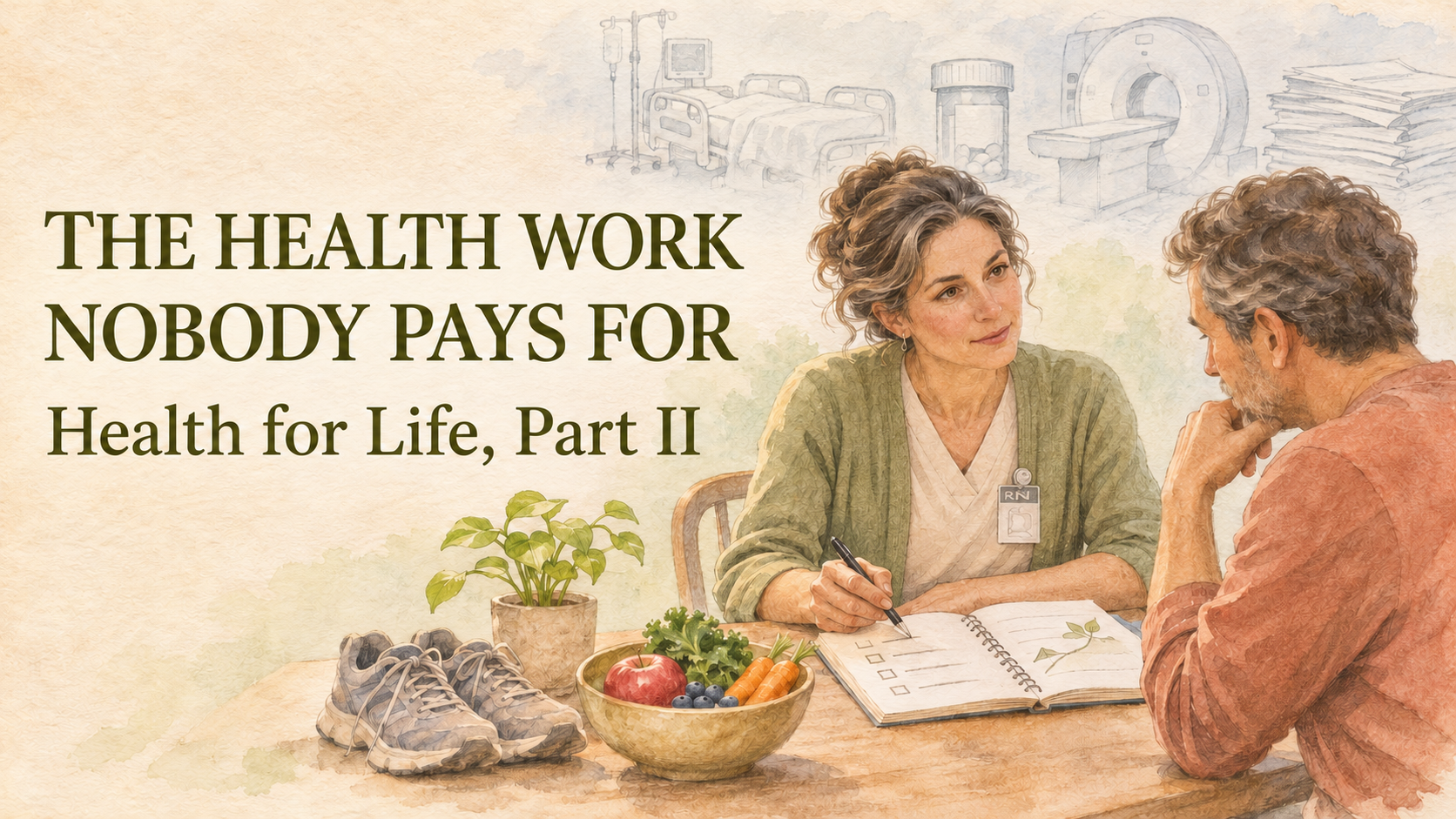
We fund the test, the drug, the device, the procedure, and the hospital bed. We still leave much of the work of keeping people well to private pay.
Here is one of the strangest things about our healthcare system: physicians came to me as patients. Even the CEO of a major hospital came to me.
I am an RN and health coach with degrees in biopsychology and nursing. They had more formal medical education, more institutional authority, and far more money. Yet they needed the kind of ongoing education, support, accountability, and practical problem-solving I could provide.
My work was private pay.
I helped people reverse Type 2 diabetes without medication—what clinical language more carefully calls remission. I helped women who had struggled with PCOS conceive. I was doing work the ordinary system had not done for them, and I could not make even a modest living doing it.
That is the problem in one sentence.
Prevention is left to be paid for out of pocket, while disease care is funded at every stage—including a physician-centered system that makes doctors the gatekeepers of care, much of which could be delivered earlier, more accessibly, and more consistently by nurses, health coaches, educators, dietitians, pharmacists, and community workers.
The doctors and administrators in the system are doing fine financially. I am living on Social Security, buying groceries on a credit card, and hoping the oil truck does not come too soon.
That is not a sob story. It is a picture of what the system pays for.
It pays when people are sick enough to need specialists, tests, drugs, devices, procedures, hospitalizations, and long-term care. It does not pay people to keep other people well.
The Work That Gets Left Behind
I am not arguing that doctors are unnecessary. I know when medical care is needed.
I had five children and spent twenty-four hours or less in the hospital after each birth. I have had two major breast-cancer surgeries. After three days following mastectomy and GAP-flap reconstruction, I demanded to be released to a hotel because I could get better care there.
At this point in my life, I often have to tell my primary-care provider which tests I need and communicate more than once to get them ordered and completed.
At every visit, I ask the same question:
If this test will not change my behavior, my treatment, or my outcome, why are we doing it? Why spend the money and waste both my time and yours?
Someone gets paid to order the test, perform it, read it, code it, bill it, and defend it. The physician may not be the one making the money.
The machine is.
Tests are essential when they answer a meaningful question and change what happens next. Yet our system almost never stops to ask whether a low-cost conversation, a nurse follow-up, a coach, a food plan, a walking group, a caregiver resource, or earlier support could prevent the problem from becoming an expensive one.
The Physician Chokepoint
We need physicians for diagnosis, prescribing, emergencies, acute care, and complex treatment.
We do not need a medical doctor carrying the whole weight of most chronic illness.
A person with prediabetes may need regular education, food support, encouragement, accountability, help understanding lab results, safe movement options, and somebody checking in before a crisis develops. A family caregiver may need help navigating appointments, medications, transportation, and exhaustion. An older adult at risk of falling may need balance work, strength support, and home-safety changes before a broken hip changes everything.
Much of that work can begin long before a specialist appointment. Much of it can be delivered effectively by trained nurses, health coaches, dietitians, pharmacists, educators, and community health workers who work with physicians rather than waiting behind them.
The CDC already recognizes trained lifestyle coaches as central to diabetes-prevention programs, and public-health guidance supports team-based care for chronic conditions such as hypertension. The idea is not radical. The failure is refusing to build and pay for it at the scale people need.
Cheaper Disease Care Is Still Disease Care
We spend enormous energy and media attention trying to lower drug prices and improve insurance coverage.
Cheaper drugs matter for people who need drugs. Better insurance matters for people who need care. Medicare for All matters because universal medical care is the floor. It is infrastructure.
But we are still accepting the premise that Americans need this much disease care in the first place.
Health for Life asks a different question:
How do we build a country where fewer people need so many drugs, procedures, devices, and expensive insurance policies?
What costs less: recovering from a broken hip after a fall, or preventing the fall?
What costs less: years of escalating diabetes medications and complications, or a health coach, a gym membership, help buying real food, cooking education, and regular support?
What costs less: waiting nine months for an appointment with a highly trained specialist, or helping someone early with the person who can actually spend time teaching, listening, following up, and helping them build a life that supports health?
This is not about taking care away from people. It is about needing less high-cost care because fewer people reach the point of crisis.
The Health-First Economy
Big Food, Big Pharma, private insurance, and a government shaped by oligarchic money all have their own interests. They do not need to meet in a secret room to create a broken system. The incentives already do the work.
We can call these interlocking systems the medical-industrial complex, the financial-industrial complex, the technology-industrial complex, and the military-industrial complex: MedIC, FIC, TIC, and MIC.
Different industries. Familiar logic.
Keep people dependent. Keep them confused. Keep them spending. Keep the money moving upward.
Michigan Senator-elect Abdul El-Sayed has given people a plain-language answer to the political layer of this mess:
Get money out of politics. Put money in your pocket. Pass Medicare for All.
He is right. But universal medical care is only the floor.
Then we need a transparent way to measure the reduced cost of disease, protect verified savings from disappearing into the general fund, and reinvest them in health, education, food access, prevention, and a stronger country.
That is how a health-first economy begins.
Be Like Water
This is a fifty-year project. That does not mean waiting fifty years to see change.
In five or ten years, we can see whether a community is moving in the right direction: fewer preventable falls, fewer chronic conditions escalating into crisis, fewer medications added because nobody had time to address the underlying problem, fewer missed workdays, shorter waits for the care that truly requires a physician, and more people reaching older age with strength, independence, connection, and purpose.
We will not outspend the people who profit from the current arrangement. We will not out-lobby them overnight. We will not wait for them to voluntarily dismantle what makes them rich.
So I keep returning to Bruce Lee:
Be like water.
We work around the system while we expose it. We educate people. We build a culture that understands health, sees the choke points, and begins making different demands.
We map who gets paid. We show who is left out. We move work upstream into prevention and education. We measure what happens when people become healthier.
One rock at a time.
Moving forward every day, starting today, in every small way—that is how we change things.
Be like water.
Want practical ways to support health before crisis? Explore the Health & Wellness Events guide, or learn more about private coaching.