
How to Overcome Decision Fatigue: Make a Done List, Not a To-Do List
How to Overcome Decision Fatigue: Make a Done List, Not a To-Do List
When everything feels overwhelming, the secret may be to stop looking at everything you haven't done.
Some days, I'm not physically incapable of doing things. I'm simply overwhelmed by the number of things that need doing. The house needs attention, the yard needs work, there are articles to write, bills to consider, websites to maintain, and seemingly a thousand little decisions competing for space in my head.
It's exhausting before I even get started.
I've learned to play little games with myself to get around that feeling. Nothing complicated, nothing requiring a planner, an app, or another system to manage. Just small challenges that turn an overwhelming task into something I can actually accomplish.
And I've discovered something interesting: once I stop thinking about everything that needs doing, I often get quite a bit done.
The Ten Little Things Game
Sometimes I tell myself I'm going to clean ten small spots. Not clean the kitchen. Not organize the house. Just ten things.
I might wipe down the front of the microwave, wash the dishes, empty the trash, sweep one section of the floor, clear off a counter, or put away something that's been sitting where it doesn't belong.
Each one counts as a victory.
The trick is to make the individual tasks so small that I don't have to negotiate with myself about starting them. I'm not committing to spending the afternoon cleaning. I'm just doing ten little things.
And when I've finished ten, I'm done. Unless, of course, I feel like doing more.
The Three Things Game
I play a similar game outside.
With winter approaching here in New England, there's a lot that needs to be put away. If I think about winterizing the entire yard, the job feels enormous.
So I tell myself to put away three things.
Two umbrellas and one lawn chair. That's three. Mission accomplished.
Tomorrow I might find another three.
Eventually, quite a lot gets done without my ever having to face the entire project at once.
It's a simple psychological trick, but it works for me. I've replaced one overwhelming decision with three easy ones.
Why Small Decisions Make a Difference
Decision fatigue describes the mental weariness that can develop when we're repeatedly making choices, weighing alternatives, and managing competing demands.
Not every decision is difficult. But when you're already under stress, even ordinary choices can begin to feel disproportionately burdensome.
What should I do first? What's most important? How long will it take? What if I don't finish? Should I be doing something else instead?
Before long, deciding what to do becomes more exhausting than doing it.
My little games take some of those decisions away. I establish a simple rule, choose a few manageable actions, and get moving.
There's no complicated prioritizing, no requirement to finish an entire project, and no need to decide what comes next until I'm ready.
Make a Done List Instead of a To-Do List
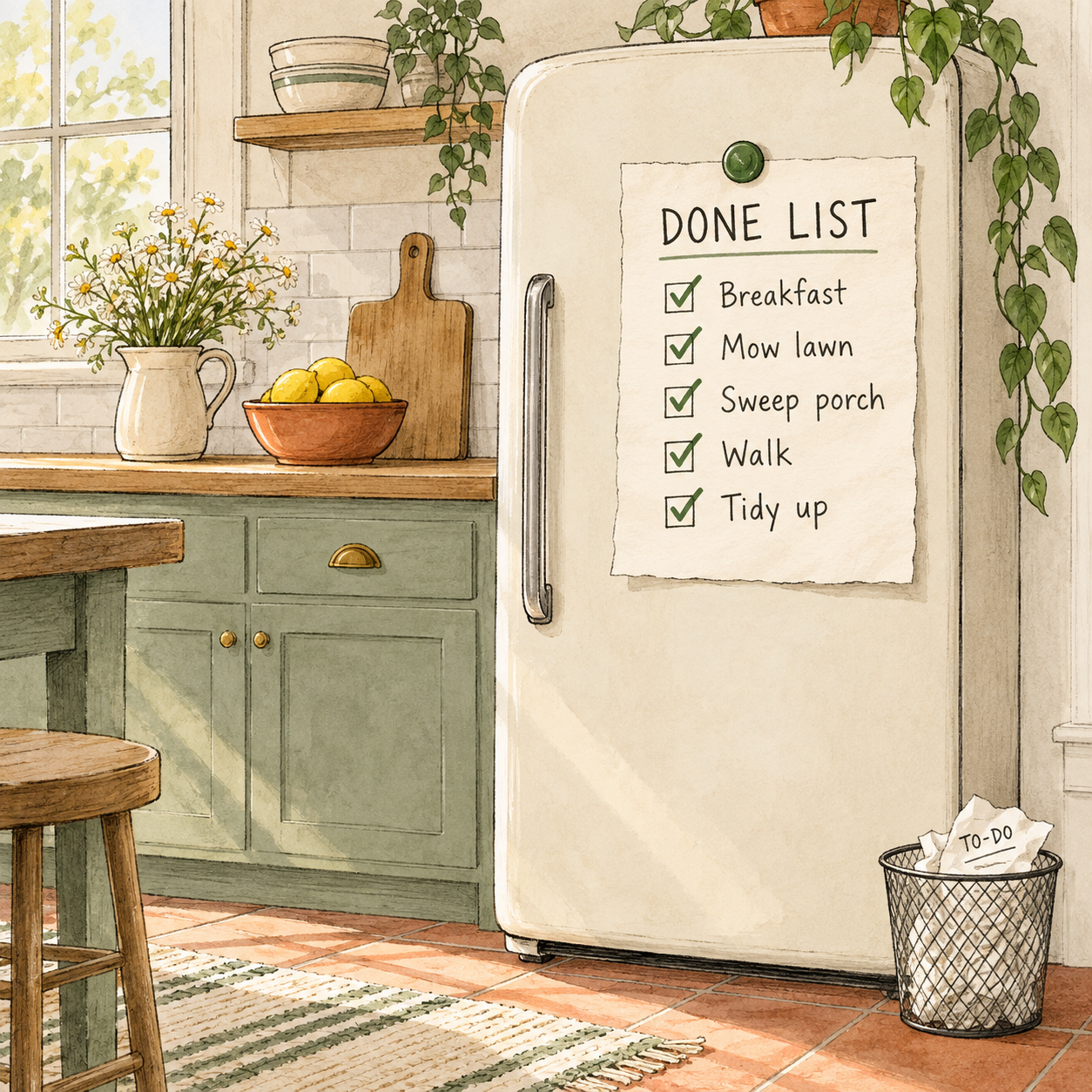
Here's another strategy I love: instead of writing a list of everything you need to do, write down what you've already accomplished.
Put it on the refrigerator.
Add to it throughout the day.
Today, for example, my list might read:
Scrambled three eggs and had breakfast.
Took my vitamins.
Mowed the lawn.
Swept the porch.
Walked in the woods.
Picked up fallen branches.
Cleared some debris into the fire pit.
Published an article.
Prepared notes for another.
That's a pretty productive day.
But without the list, I might spend the afternoon thinking about everything I haven't done yet.
A to-do list can become a running inventory of unfinished obligations. A done list is evidence of effort, progress, and accomplishment.
It changes the question from What haven't I done? to What have I accomplished?
And for someone who's already overwhelmed, that can make an enormous difference.
Give Yourself Permission to Stop
There's another important part of these little games: the finish line.
If I decide to put three things away, I don't have to put away thirty. If I decide to clean ten little spots, I don't have to clean the entire house.
I can stop when I've completed my challenge.
Sometimes getting started creates enough momentum that I naturally want to keep going. Other times, ten things really are enough.
Both outcomes are successes.
This is especially important as we get older, when energy, physical limitations, disrupted sleep, and competing responsibilities can make it harder to accomplish everything we'd like to do in a day.
And it matters at any age when stress, caregiving, work, or financial worries are consuming our mental bandwidth.
Rest doesn't have to be something we earn by finishing every unfinished task. That day may never come.
Progress Doesn't Have to Be Exhausting
I think we've become so accustomed to measuring productivity by how much remains undone that we forget to acknowledge what we've accomplished.
We make lists that grow faster than we can cross things off. We tackle enormous projects in our heads before we've picked up the first dish or put away the first lawn chair.
And then we wonder why we're exhausted.
Perhaps we need to change the game.
Clean ten little spots. Put away three things. Take a short walk. Do one small task that's been bothering you.
Then write it down.
Put your Done List on the refrigerator where you'll see it.
At the end of the day, instead of looking around for evidence of what you failed to accomplish, take a moment to appreciate what you actually did.
You don't have to finish everything to have accomplished something.
And sometimes, that's exactly how you get your momentum back.