
Don’t Go Shopping When You’re Hungry
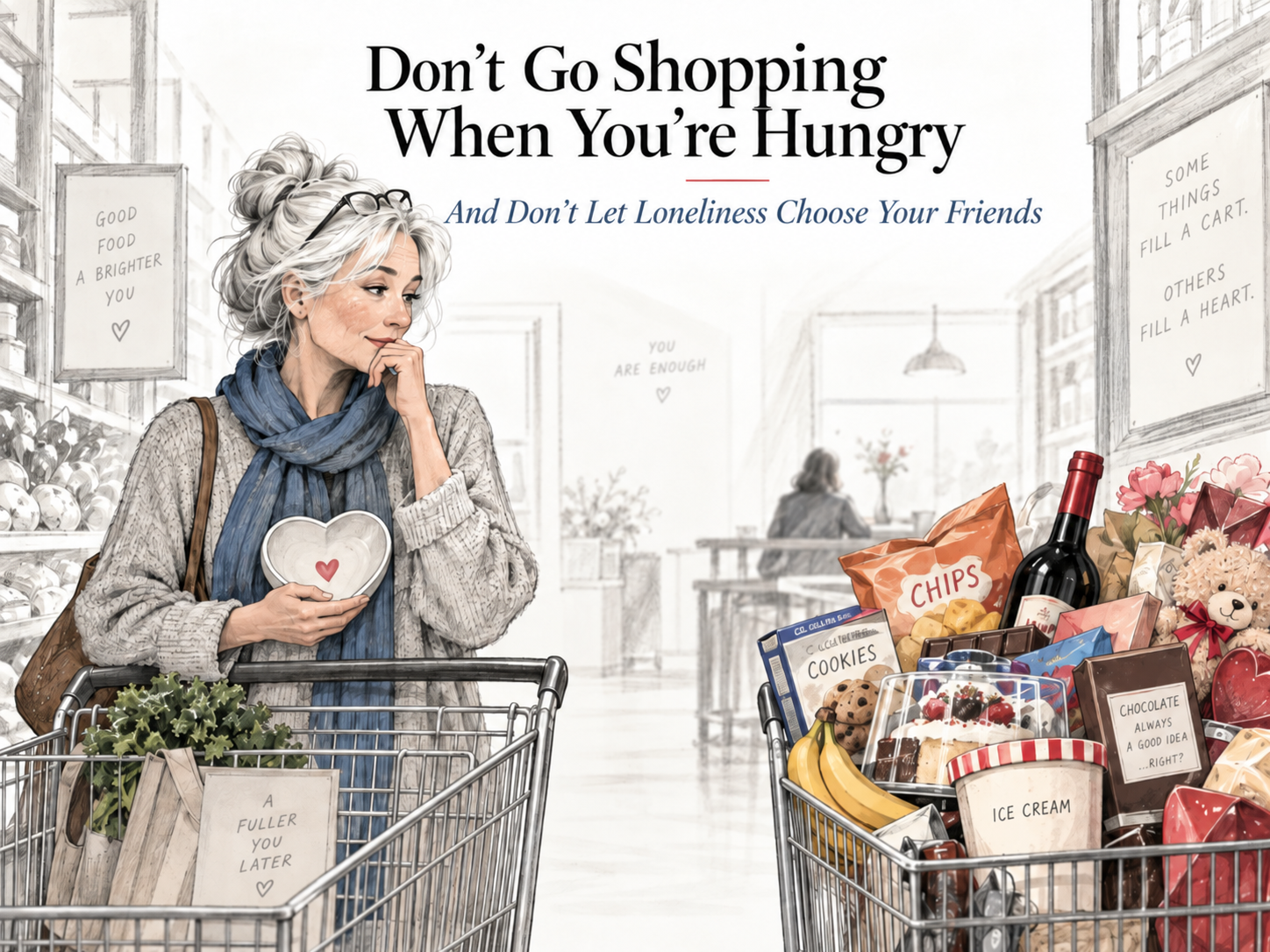
Don’t Go Shopping When You’re Hungry — And Don’t Let Loneliness Choose Your Friends
And Don’t Let Loneliness Choose Your Friends
There is an old piece of advice that says: don’t go grocery shopping when you’re hungry. The reason is simple. When you are hungry, everything looks good. You buy too much, reach for things you would not normally choose, and make decisions based on an immediate need instead of what will actually nourish you.
I think relationships can work the same way. When you are lonely, unseen, depleted, grieving, insecure, or simply starved for connection, attention can feel much more valuable than it really is. Someone notices you, listens to you, seems fascinated by you, wants to talk every day, or tells you how much they understand you. Before you know it, they may have been given access to parts of your life that they have not yet earned.
Emotional Hunger Changes Judgment
Loneliness is powerful because it can change the value we place on attention. An ordinary amount of interest can suddenly feel extraordinary. Intensity can feel like intimacy. Validation can feel like genuine affection. Familiarity can feel like safety.
That does not mean you should avoid friendship when you are lonely. Human connection is essential to emotional and physical well-being. The point is much simpler: emotional hunger can affect judgment just as physical hunger can affect what lands in your grocery cart.
When your emotional reserves are running low, the question can quietly shift from “Is this person good for me?” to “Does this person want me?” Those are very different questions. The second one can make us overlook information that we might recognize much more quickly if we were feeling stronger, more connected, and more confident.
Familiar Does Not Always Mean Safe
Many of us become remarkably skilled at interacting with difficult people. If you grew up around people who were entitled, controlling, defensive, volatile, dismissive, or emotionally manipulative, you may have spent years learning how to anticipate moods, soothe egos, avoid conflict, explain yourself carefully, or keep another person happy.
Those skills may have helped you navigate your earlier life. They can also make unhealthy behavior seem remarkably ordinary later.
You may instinctively know how to reassure someone who constantly needs validation. You may know how to calm someone who becomes defensive when corrected. You may tolerate someone who turns small disagreements into battles, needs to be right, or repeatedly expects you to become involved in their grievances with other people.
You know the dance. That can be precisely the problem.
Sometimes what feels like an immediate connection is partly recognition. We think, I understand this person so well. What we may actually be recognizing is a relationship pattern we already know how to manage.
Familiarity can masquerade as chemistry. Attention can masquerade as care. Intensity can masquerade as intimacy.
Attention Is Not the Same as Care
Someone can give you enormous amounts of attention without necessarily caring about your well-being. They can message constantly, compliment you, confide in you, praise you, tell you how different you are from everyone else, or seek immediate emotional closeness.
That attention can feel wonderful, particularly when you have been lonely.
But care is demonstrated differently. Care becomes visible over time. It respects your boundaries. It allows you to have other relationships and interests. It does not demand constant reassurance. It does not require you to take sides in every disagreement. It does not punish you for being unavailable, disagreeing, or saying no.
Someone making you feel seen is meaningful. But feeling seen should not automatically be confused with being safe.
Watch What Happens When You Disagree
We often evaluate new relationships during their easiest moments. Someone is interested in us, we enjoy talking with them, and everything feels comfortable. But compatibility is not really tested when two people agree.
Watch what happens when you disagree.
Notice what happens when you correct someone, decline something, become unavailable, support someone they dislike, fail to provide the reassurance they expected, or simply have an opinion they do not share.
Can they remain respectful? Can they tolerate being wrong? Can they hear another point of view without treating disagreement as rejection? Can they take responsibility without immediately becoming defensive? Can they accept that your time, attention, and other relationships belong to you?
You can learn more about someone during five minutes of disagreement than during five hours of compliments.
Let Trust Catch Up With Connection
You do not have to become suspicious of everyone. Healthy relationships require openness, and wonderful friendships sometimes begin unexpectedly.
But there is no reason to rush access.
Someone can be interesting without immediately becoming intimate. Someone can be supportive without becoming central to your life. Someone can feel familiar without automatically becoming trusted.
Let trust develop through repeated evidence.
Watch how someone talks about people who have disappointed them. Notice whether everyone in their past eventually becomes the villain. Pay attention to whether they repeatedly recruit you into conflicts that have nothing to do with you. Notice whether they can apologize, reconsider, and change course.
And notice what happens inside you.
After interacting with this person, do you generally feel supported and comfortable? Or are you increasingly tense, obligated, exhausted, confused, or replaying conversations in your head?
Your reactions are information.
Keep Your Own Bucket Full
One of the best protections against unhealthy relationships is not becoming an expert at diagnosing other people. It is reducing the emotional hunger that makes any offer of connection feel irresistible.
Think of your emotional life as a bucket. You do not need it perfectly full. Nobody's is. But the emptier that bucket becomes, the more powerful someone else's attention can feel.
Fill it from multiple places.
Maintain several kinds of connection rather than allowing one new person to become your entire social world. Protect interests that belong only to you. Find purpose in work, creativity, learning, movement, volunteering, family, community, animals, nature, or whatever genuinely restores you. Develop confidence that is not entirely dependent on another person's approval.
The fuller your life becomes, the easier it is to distinguish between wanting a relationship and wanting this particular relationship.
Instead of thinking, At least somebody wants me, you become more able to ask, Do I actually want this person this close to me?
That is an important question.
Loneliness Is Not a Character Flaw
There is nothing shameful about being lonely. There is nothing weak about wanting someone to see you, call you, listen to you, laugh with you, or care whether you had a good day.
Connection is a human need.
The danger begins when hunger persuades us to ignore information. We explain away excessive defensiveness. We excuse entitlement. We tolerate constant conflict. We become responsible for providing reassurance. We accept being pulled into other people's disputes. We repeatedly leave conversations feeling depleted and convince ourselves that this is simply what friendship requires.
It isn't.
Sometimes loneliness hurts. But an unhealthy relationship can eventually make solitude feel peaceful by comparison.
Slow Down and Watch
The goal is not to become afraid of new relationships. The goal is to give yourself enough time to see what you are actually being offered.
Let someone encounter a boundary. Let them hear no. Let them discover that you cannot always respond immediately. Let them see you disagree. Let them learn that you have other friends, other interests, other responsibilities, and a life that does not revolve around them.
Then watch what happens.
You do not need to diagnose another person to recognize that a relationship is costing you more than it gives you. You do not need proof that someone is intentionally hurting you before deciding that a particular dynamic is unhealthy for you.
Don’t go shopping when you’re hungry. And don’t let loneliness choose your friends.
Choose friendship because someone consistently demonstrates kindness, respect, reciprocity, accountability, and genuine concern for your well-being — not simply because they arrived while your emotional bucket was empty.
Want to Explore These Relationship Patterns More Deeply?
I write more extensively about unhealthy relationship dynamics, emotional manipulation, coercive control, boundaries, entitlement, and the patterns that can be difficult to recognize while we are living inside them at Domestic Assault.
You can visit my Substack at DomesticAssault.com.
The goal is not to label every difficult person or every uncomfortable relationship as abuse. It is to become better at recognizing patterns, trusting what you observe, and protecting your emotional well-being before an unhealthy dynamic becomes deeply rooted in your life.