
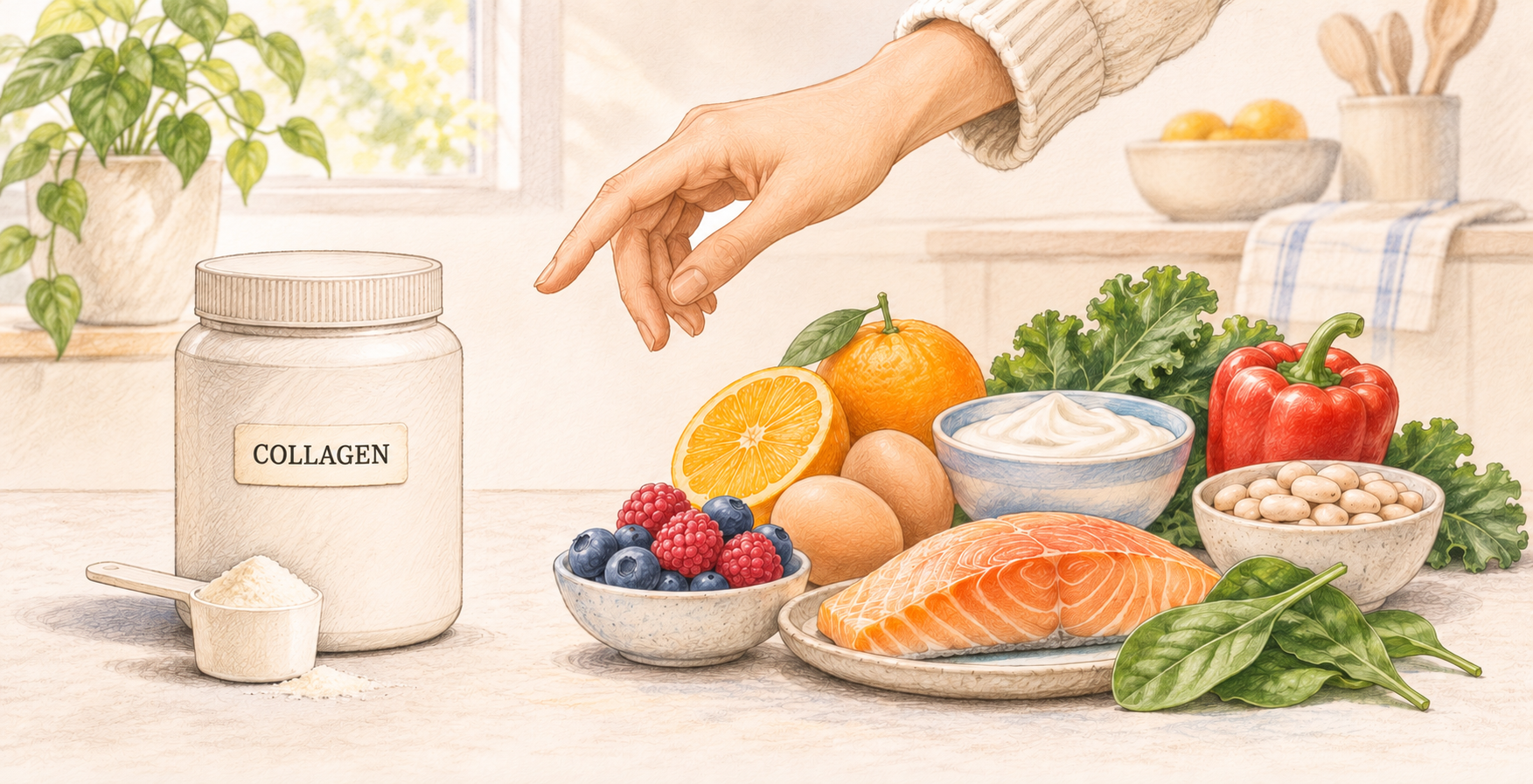
A supplement can be useful. It should not have to carry the whole job.
I have gone back and forth on collagen supplements.
The marketing story is easy to believe: our bodies make less collagen as we age. Collagen is important for skin, tendons, ligaments, bones, blood vessels, and other connective tissue. Therefore, taking collagen must replace what we are losing.
It sounds logical.
But simple marketing stories are often much simpler than human biology.
Collagen supplements are not useless. They are not fraud in a tub. But they are also not a direct delivery system that sends a scoop of powder to your wrinkles, your hair, your aching knees, or your sore shoulder.
For most people, collagen is an optional supplement—not a foundation of health.
What Actually Happens When You Take Collagen?
Collagen is one of the main structural proteins in the body. It helps give strength and structure to skin, tendons, ligaments, bone, blood vessels, and other connective tissue.
That is why the marketing story is so persuasive: collagen matters in the body, so taking collagen must replenish collagen.
But your body does not work that way.
When you swallow collagen, stomach acid and digestive enzymes break it down into amino acids and small peptides. Some collagen-related peptides do make it into the bloodstream. That is real.
But they enter a general pool of building materials. Your body uses those materials where it determines they are needed most. A scoop of collagen has no address label telling it to go directly to your cheeks, your hair, your knees, or your sore shoulder.
Some small peptides, including hydroxyproline-containing peptides, may also send signals involved in fibroblast activity. Fibroblasts are cells that help build and maintain connective tissue. That is one reason collagen research remains interesting.
But biological plausibility is not the same as a proven clinical result.
The useful question is not, “Can collagen be absorbed?”
It can.
The useful question is, “Does taking it produce a meaningful improvement in the thing I care about?” Skin? Joint pain? Function? Recovery? Hair? And is that improvement worth the money compared with getting enough protein, vitamin C, and good food in the first place?
What the Research Actually Says
Collagen research is mixed.
Some studies and reviews report modest improvements in skin hydration and elasticity, especially after several months of daily use. A recent meta-analysis found signals for improved hydration, elasticity, and skin-barrier function. It did not find robust evidence that collagen reduces wrinkles or changes the deeper structure of aging skin.
That is a much more modest claim than the marketing.
A 2025 systematic review of 23 randomized trials found apparent benefits for skin hydration, elasticity, and wrinkles when all studies were pooled. But when researchers looked specifically at higher-quality trials and trials not funded by industry, those benefits disappeared.
Their conclusion was blunt: there was not clinical evidence to support collagen supplements for preventing or treating skin aging.
That does not mean every person who thinks collagen helps them is imagining it. It means we should not sell collagen as a proven anti-aging treatment.
For knee osteoarthritis, there is some evidence that certain collagen products may improve pain and function for some people. But the products, doses, study populations, and outcomes vary widely. Other trials have found no meaningful advantage over placebo.
Collagen may be worth a personal trial for a specific reason. It is not a replacement for diagnosis, physical therapy, strength work, appropriate medical treatment, or understanding why something hurts.
Collagen Is Not Your Main Protein Plan
This is one of the most important things to understand.
Collagen contains protein, but it is not a complete protein. It lacks tryptophan, one of the amino acids your body needs from food. That makes it a poor choice for replacing eggs, fish, poultry, meat, dairy, soy, legumes, or a well-formulated protein powder.
If you are using collagen in coffee and calling that breakfast, you may be missing the larger opportunity.
A better question is:
Am I getting enough real protein across my day?
For many adults—especially as they age—that is a more useful place to spend attention and money.
Whole-food protein also brings other nutrients along with it. Eggs bring choline. Fish brings omega-3 fats. Greek yogurt may provide calcium. Beans and lentils offer fiber. Meat, poultry, and seafood can provide iron, zinc, vitamin B12, and other nutrients depending on the food.
Collagen does not replace that job.
What Your Body Needs to Make Collagen
Your body makes collagen from amino acids. It also needs vitamin C, which is required for collagen biosynthesis.
That means your body benefits from:
Enough total food and enough protein.
Vitamin C-rich foods such as citrus, berries, kiwi, peppers, tomatoes, broccoli, and potatoes.
A generally varied diet that provides the nutrients involved in tissue repair and maintenance.
Not smoking.
Sun protection for skin.
Strength and movement that help maintain muscle, bone, balance, and function.
Sleep and recovery.
None of those things are glamorous. They also matter more than one scoop of powder.
Eating protein and vitamin C does not stop aging or guarantee perfect skin. It simply gives your body raw materials it needs to do work it is already designed to do.
When Collagen Might Be Reasonable
Collagen can be reasonable if you understand what it is and what it is not.
You may decide to try it if:
You enjoy using it and can afford it.
You want to see whether it makes a modest difference in skin hydration or a specific joint symptom.
You are already eating enough balanced protein.
You understand that “may help” is different from “will fix.”
You are willing to try it for a defined period, then decide whether it is worth continuing.
A fair personal experiment might be three months. Pay attention to the outcome you actually care about. Do not keep buying something indefinitely just because the label says you should.
Also pay attention to the source. Collagen often comes from bovine, marine, chicken, or shellfish sources. Allergies matter. So do other medical conditions, medications, and dietary needs.
When It Is Probably Not Your First Purchase
Collagen should move down the list if:
You are not eating enough protein in the first place.
You are skipping meals and hoping a powder will make up for it.
You have new or significant joint pain, swelling, weakness, injury, hair loss, digestive symptoms, or unexplained weight change that needs evaluation.
You are stretching a limited budget.
You are expecting it to rebuild cartilage, erase wrinkles, reverse aging, or replace medical care.
A $40 tub of collagen is not automatically a better investment than eggs, beans, fish, Greek yogurt, frozen vegetables, fruit, or a practical protein powder that helps you meet a real protein gap.
My Supplement Philosophy
I do not believe people need a shelf full of supplements.
I believe supplements can be useful when they solve an actual problem.
Sometimes that means correcting a documented deficiency. Sometimes it means a protein powder that helps someone meet their needs on busy days. Sometimes it means vitamin D, magnesium, creatine, omega-3s, or another targeted product after we have looked at the person, their food, their symptoms, their medications, their health history, and—when appropriate—their lab work.
The point is not to buy more.
The point is to buy what is useful.
That is why I will sometimes tell you a supplement is optional. It is why I will sometimes tell you food comes first. And it is why I will never recommend something simply because it is popular, profitable, or easy to put in a cart.
Collagen may be part of someone’s routine. It does not have to be part of yours.
A Question for You
What supplement are you wondering whether you actually need?
Send me your question through the TotalWellCoach contact page. It may become a future article.
If you want help sorting through protein, supplements, lab results, energy, weight, or healthy-aging questions, you can learn more about private coaching.
You can also browse the TotalWellCoach Apothecary. It is there for people who want access to products I am comfortable discussing—not because everyone needs a supplement shopping list.
Affiliate disclosure: If you choose to purchase through this link, I may earn a small commission at no additional cost to you. I only recommend products when I believe they may be genuinely useful.
This article is for education and general information. It is not individual medical advice. Discuss supplements with a qualified clinician or pharmacist if you have medical conditions, take medications, are pregnant, or have food allergies.