
What families miss when a young man seems stuck—and why health, belonging, guidance, and a real runway matter.
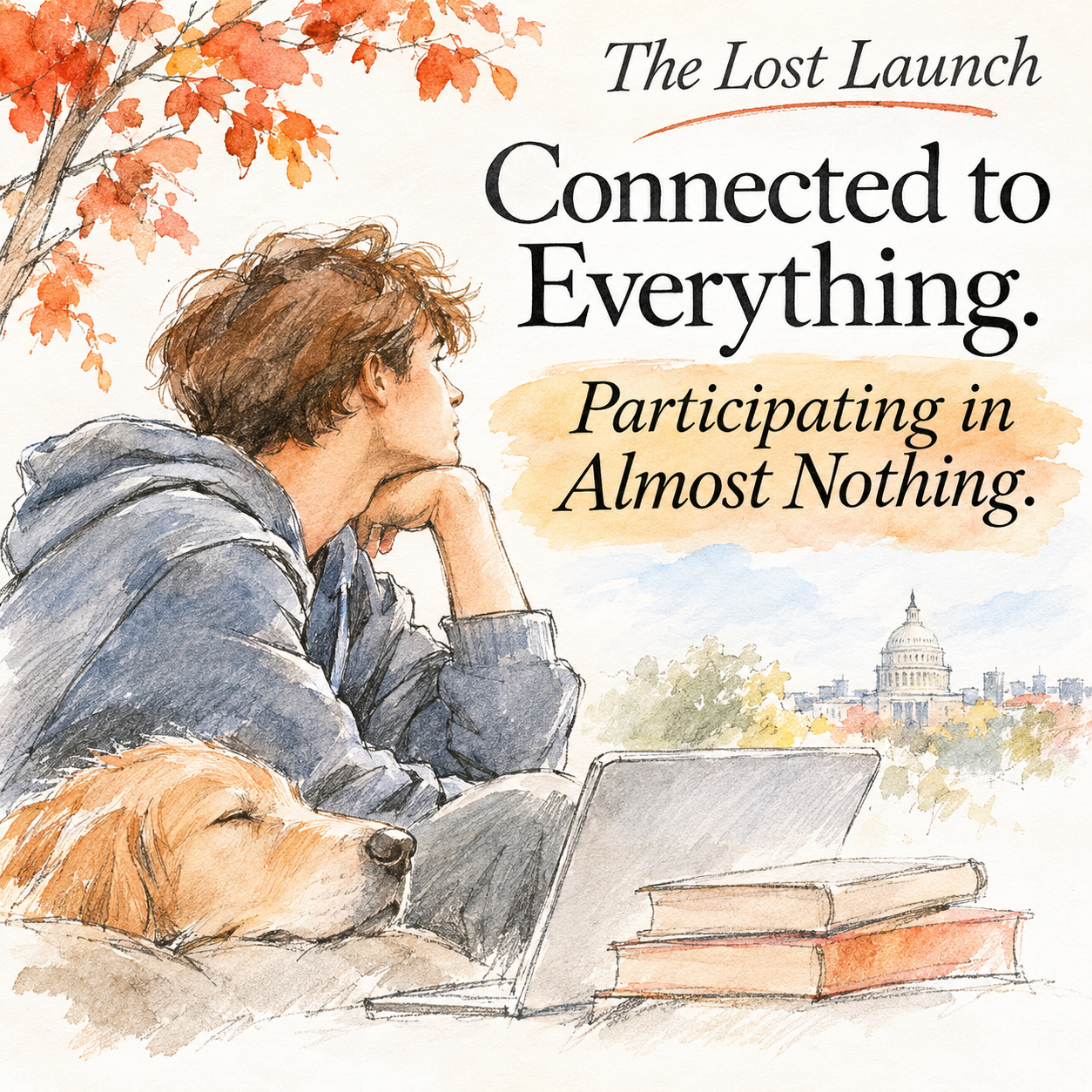
Connected to everything. Participating in almost nothing.
He has a phone, information, entertainment, opinions, group chats, games, videos, and access to more of the world than any generation before him.
He may know what is happening everywhere.
Yet he is participating in almost nothing.
No work that feels like it leads somewhere. No team. No real routine. No place where someone depends on him. No role in the community. No confidence that he can build an independent life. Maybe no dating, no close friendships, no idea how to begin.
This is the lost launch.
It is often described as “failure to launch,” as if the young man himself is the defective part. Then come the labels: lazy, entitled, addicted, man-child, loser, unemployable.
That is the wrong place to begin.
The young men caught in this pattern care about success, happiness, independence, love, friendship, and meaningful lives. They want to feel capable. They want to matter. Stereotyping them as lazy or uncaring teaches them that the people closest to them have already decided who they are.
A World of Watching Instead of Participating
The Census Bureau reports that 58% of Americans ages 18 to 24 lived in a parental home in 2025. Sixteen percent of people ages 25 to 34 did too.
Living with family is not automatically a problem. It can be loving, practical, financially smart, and culturally normal.
A home can be a launching pad.
It can also become a holding pattern.
Nearly half of Americans ages 25 to 34 had reached four traditional adult milestones in 1975: living independently, working, marrying, and raising children. Today, fewer than one in four have reached all four.
I am not interested in forcing young people into an old checklist of adulthood. I am interested in what happens when someone loses the ordinary markers that say: I am growing. I am useful. I am building a life.
A person can spend all day consuming information and still have no place in the real world where their presence matters.
What Families Miss
When a young adult appears stuck, families become scared.
Parents may worry about money, drugs, screens, unemployment, social isolation, mental health, and the future. They may be exhausted. They may feel judged by friends and relatives. They may be carrying their own grief over the life they imagined for their son.
That fear can turn a family into a pressure cooker.
One parent becomes the critic. Another becomes the rescuer. A young man becomes defensive, secretive, withdrawn, angry, or ashamed. Every conversation becomes about what he has not done yet.
Then the pattern hardens.
Some families use shame: comparisons, insults, threats, lectures, money as leverage, and housing as a weapon. Some families overcorrect with rescue: no expectations, no structure, no contribution, no plan, and no honest conversation.
Neither one builds adulthood.
Tough love is not abandonment, abuse, financial deprivation, emotional cruelty, or domestic assault.
Tough love means clarity, expectations, consequences, practical help, respect, and a path. It says: “I believe you can do this. I will not humiliate you. I will not carry you forever. Let’s make a real plan.”
A home becomes a launching pad when help comes with dignity, structure, and a next step.
Fathers Who Left—and Fathers Who Checked Out
Fathers matter in this story.
Some fathers left physically. Some stayed in the house but checked out emotionally. Some could not show affection, admit fear, keep promises, apologize, or model how a man handles rejection, work, grief, or disappointment without rage, alcohol, cheating, withdrawal, or blame.
A boy can grow up being told to be tough, independent, successful, sexually confident, financially secure, and emotionally invulnerable—while receiving no trustworthy example of how to become that man.
Too many mothers are left carrying the financial, emotional, and practical work of raising sons into men. They become the organizer, the comforter, the disciplinarian, the safety net, and often the person blamed when they cannot fill every missing role.
We should not be surprised when a young man struggles to build a life if the adults around him have taught him that needing guidance is weakness.
The Public Example Is Rotten Too
The family is not the whole story.
Young men are watching the men who run this country.
Donald Trump has made one lesson very loud for over ten years: dishonesty, cruelty, sexual degradation, cheating, humiliation, and escape from accountability can look like power when institutions reward them.
Young men see it.
They see wealthy men break rules, hurt people, call it winning, and remain admired. They see a culture that tells them to work hard, respect women, be honest, and take responsibility—then rewards public men who do the opposite.
That is public-health messaging whether we call it that or not.
A decent young man can look around and wonder whether decency is for suckers. We cannot lower the moral bar for powerful men and then act surprised when younger men lose faith in the whole structure.
The Health Cost of Being Stuck
A stalled life gets into the body.
Sleep drifts when there is no reason to get up. Food gets worse when days have no structure. Movement disappears. Appointments are postponed. Anxiety rises. Depression can look like irritability, avoidance, exhaustion, or a person who simply “doesn’t care.”
The CDC identifies young adults as one of the groups especially affected by loneliness and social disconnection. Isolation is associated with higher risks of depression, anxiety, Type 2 diabetes, heart disease, stroke, and earlier death.
Connection is health infrastructure.
A job is not only income. A team is not only exercise. A class is not only education. A walk is not only steps. These are places where people are expected, seen, useful, and connected to something beyond a screen.
Alcohol, Cannabis, and the Ways People Disappear
We also need to say alcohol and cannabis out loud.
In 2024, 47.5% of people ages 18 to 25 reported drinking alcohol in the previous month, and 24.1% reported using marijuana in the previous month.
Those figures do not make every young adult a problem. They tell us these substances are common enough that we should stop pretending they are irrelevant.
Alcohol can damage sleep and worsen anxiety. Cannabis can become a way to shut life off for a few hours. When either one starts replacing work, relationships, movement, savings, plans, or the ability to tolerate an ordinary day, it needs an honest look.
Then there are the other exits: gambling apps, pornography, gaming, endless scrolling, food delivery, highly processed food, shopping, and the constant small reward of clicking one more thing.
These are ways people cope when life feels too empty, frightening, expensive, or impossible to enter.
But a country that makes numbness easier than belonging should not be surprised when people choose numbness.
Dignity Comes Before Direction
These young men want success more than we want it for them.
They do not want to be carried, managed, spoken about as a problem, or shoved toward somebody else’s version of adulthood. They want to feel capable, respected, wanted, and trusted to build a life that means something.
That does not mean pretending nothing is wrong. It means starting with the belief that the person in front of you wants more for his life than anyone else can want it for him.
Panic makes families push. Fear makes them lecture. Shame makes them tighten control. But control can take the last bit of dignity a young man has left.
Trust is different.
Trust says: “I know you are in there. I know this is not the life you want. I love you. I believe you can build something better. I will not humiliate you, and I will not pretend this is working. Let’s find the next best step.”
The next best step does not have to be moving out, finding a career, getting married, or fixing every problem at once.
It may be getting up at the same time for one week. Making one appointment. Going for a walk. Calling someone back. Helping with a real responsibility at home. Applying for one job. Showing up for one class. Taking one day without alcohol, cannabis, gambling, gaming, or whatever else has become the place to hide.
The exact next step has to belong to him.
Families can offer guidance, boundaries, resources, encouragement, and truth. They cannot build a grown man’s life for him. They can, however, stop making it harder for him to believe he is capable of building one.
Some situations require medical care, therapy, addiction treatment, or a more structured plan. Even then, connection matters. A young man should never have to earn the right to be treated with basic dignity.
Trust your sons enough to see the man underneath the stuckness.
Love your sons enough to avoid using shame and “tough love” as fuel.
Then help them find the next best step—and let that step belong to them.
Finding the Next Best Step
If you are a young adult who feels stuck—or a parent trying to help without shaming, rescuing, or giving up—you do not have to solve everything at once.
A private coaching conversation can help identify what is getting in the way and find one practical next step forward.