
Healthy Aging Isn't Just About Living Longer. It's About Staying Capable.
Why strength, balance, reaction time, nutrition, and everyday movement matter more than the number of candles on your birthday cake.
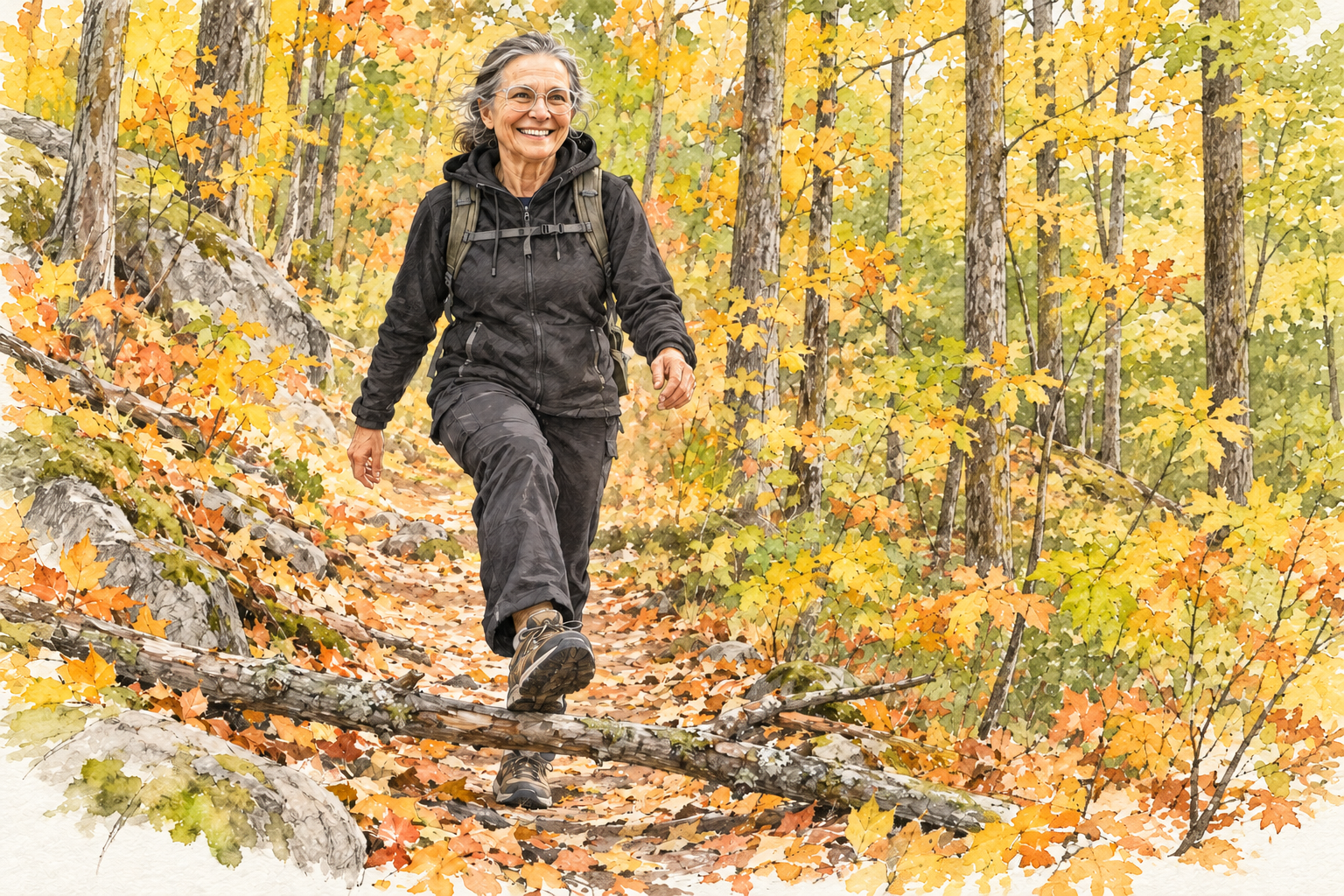
Healthy aging isn't about avoiding every obstacle. It's about maintaining the ability to navigate them.
I had an interesting experience while walking in the woods behind my house recently. I squatted down to pick something up, and before I quite understood what had happened, I found myself sitting on my bottom.
I wasn't hurt. I hadn't fallen from a standing position, and there was no dramatic tumble. I'd simply lost my balance while squatting and hadn't corrected my position quickly enough to prevent an unexpected landing.
It was a small incident, but it got me thinking.
I'm 73 years old, and I've spent most of my life being physically active. I maintain my six-acre property, mow the lawn, clear brush, haul branches, and regularly walk in the woods. I still enjoy using my 40-pound backpack leaf blower, sometimes for hours at a time. I'm not particularly interested in surrendering those activities simply because I've accumulated another birthday.
But lately, I've noticed something subtle. My body doesn't always seem to respond quite as quickly as I expect it to when I change position or shift my weight. It's not dizziness or feeling faint. It's more an awareness that the automatic adjustments I've relied on all my life may not be quite as quick as they once were.
With my nursing background, years of coaching, and personal history of chemotherapy-induced neuropathy, I recognize that there are several possible explanations. A new change in balance deserves medical evaluation rather than an assumption that it's simply aging.
But the experience also reminded me of something I've emphasized throughout my years working in health and wellness.
Healthy aging isn't just about avoiding disease or extending life. It's about maintaining the physical capacity to live the life you want.
We Measure Aging by the Wrong Numbers
We spend an extraordinary amount of time measuring health through numbers. Weight, body mass index, cholesterol, blood pressure, blood glucose, body fat percentage, and even biological age have become familiar markers in our pursuit of longevity.
These measurements can provide useful information, but they don't necessarily tell us how well we're functioning.
Can you get up from the floor without assistance? Can you carry groceries, climb stairs, maintain your balance on uneven ground, or recover when you unexpectedly stumble? Can you get out of a chair comfortably, lift something from a shelf, or continue doing the household and outdoor activities you enjoy?
These are practical measures of health that deserve at least as much attention as the number on the bathroom scale.
A person can have a perfectly acceptable body weight and still be losing muscle strength. Someone can walk several miles a day yet have surprisingly poor balance. Another person may appear physically fit but struggle to get up from the ground because they haven't maintained the strength, mobility, or coordination required for that movement.
When I think about healthy aging, I think about preserving these abilities. They are fundamental to independence.
1. Muscle Strength: The Foundation of Independence
Muscle loss is one of the most important physical changes associated with aging. The age-related decline in muscle mass, strength, and function is often described as sarcopenia, although loss of muscle strength can occur even when muscle mass hasn't changed dramatically.
We need muscle for far more than appearance or athletic performance.
Muscles allow us to rise from a chair, climb stairs, carry groceries, maintain posture, stabilize joints, and respond when we lose our balance. They also play important roles in glucose metabolism and overall metabolic health.
And there's an important difference between simply having muscle and being able to use it effectively.
Muscle power, which involves generating force quickly, matters when we need to catch ourselves during a stumble or respond to an unexpected change in position. A person may have sufficient strength for a slow, controlled movement but struggle when that same movement requires a rapid response.
The encouraging news is that older adults can improve strength through appropriately designed resistance exercise. The National Institute on Aging emphasizes the value of strengthening activities for preserving function and reducing fall-related risks.
You don't necessarily need a gym membership or elaborate equipment. Resistance bands, light weights, supervised body-weight exercises, and repeated sit-to-stand movements can all be useful, depending on your abilities.
The important thing is to provide muscles with an appropriate, progressive challenge.
Walking is wonderful exercise, but walking alone generally isn't enough to preserve every aspect of strength.
2. Balance Is More Complicated Than Standing on One Foot
Balance is an extraordinary coordination of several systems working together, usually without our conscious awareness.
Your eyes provide information about your surroundings. Your inner ear helps detect movement and position. Sensory nerves in your feet, muscles, and joints communicate information about where your body is in space. Your brain integrates those signals and directs your muscles to make the adjustments necessary to keep you upright.
One important part of this process is proprioception, sometimes described as our body's internal position sense.
You don't have to look at your feet to know where they're positioned. Your nervous system is constantly providing that information.
But when sensory feedback is diminished, maintaining balance can become more challenging, particularly on uneven surfaces or in poor lighting.
This is especially relevant for people living with peripheral neuropathy, including neuropathy associated with diabetes, certain medications, or chemotherapy.
I developed neuropathy following cancer treatment years ago. That history makes me particularly interested in whether changes in sensory feedback could be contributing to what I've recently noticed. It's a possibility to investigate, not a diagnosis I've made for myself.
Balance can often be improved with appropriate training. Tai chi, supported balance activities, and progressive exercises that challenge stability can be valuable.
But there's an important distinction between training balance and investigating a new balance problem.
New or worsening unsteadiness should not automatically be attributed to age. A healthcare professional may need to evaluate strength, sensation, gait, vision, medications, blood pressure, and neurological function. Sudden loss of balance or coordination can also be a medical emergency.
3. Reaction Time: Sometimes a Fraction of a Second Matters
When we think about physical fitness, we usually think about strength, endurance, and flexibility. Reaction time receives much less attention.
Yet the ability to respond quickly to an unexpected event can make the difference between regaining balance and landing on the ground.
Consider what happens when you catch your foot on a raised sidewalk, step onto an unstable surface, or shift your weight farther than you intended. Your nervous system must recognize the change, process the information, and activate the appropriate muscles to correct your position.
This process is remarkably fast, but it isn't necessarily unchanged throughout life.
Reaction time, sensory processing, muscle power, and coordination can all influence how effectively we respond.
The solution isn't simply to move faster. In fact, rushing can increase risk when our bodies need more time to respond.
A better approach is to maintain strength, practice appropriate balance and coordination activities, pay attention to our surroundings, and move with intention.
There is no prize for bending down, standing up, or navigating uneven terrain faster than necessary.
As someone who has spent decades coaching athletes, I understand the importance of training movement patterns. We practice skills so that the body learns to respond efficiently and reliably.
That principle doesn't disappear when we stop competing. It becomes increasingly relevant to everyday life.
4. Nutrition: You Cannot Maintain Muscle Without Nourishing It
This brings me back to a subject I've been discussing frequently at TotalWellCoach: protein.
For years, our culture has been preoccupied with weight loss. We've been encouraged to eat less, weigh less, and celebrate the declining number on the scale.
But particularly as we age, weight loss without attention to muscle preservation can come at a significant cost.
If we lose substantial muscle along with body fat, we may end up weighing less while becoming physically less capable.
That isn't necessarily an improvement in health.
Protein provides the amino acids necessary for muscle maintenance and repair. Adequate total nutrition also supports energy, recovery, nerve function, and bone health.
The standard adult protein Recommended Dietary Allowance is 0.8 grams per kilogram of body weight per day. That is a baseline recommendation, not necessarily the ideal intake for every older adult seeking to preserve or build muscle. Individual needs depend on health, activity, kidney function, and other factors.
Food should be the foundation whenever possible. Eggs, fish, poultry, meat, yogurt, dairy products, beans, and other protein-containing foods can contribute to daily intake. Supplements can be useful when food alone doesn't meet individual needs, but they aren't a substitute for an adequate, varied diet.
Protein also works best as part of a comprehensive approach that includes resistance exercise and sufficient overall calories.
And nutrition isn't only about protein. Inadequate energy intake, dehydration, and deficiencies in certain nutrients can affect physical function and overall well-being.
This is one reason I've become concerned about approaches to weight management that focus almost exclusively on making the scale move downward.
The real goal should be to become healthier and more capable, not simply smaller.
5. Environmental Awareness: Independence Includes Knowing When to Adapt
There's another component of healthy aging that we sometimes overlook: the environment in which we move.
A loose rug, poorly lit staircase, uneven trail, icy walkway, inappropriate footwear, or heavy object carried while navigating obstacles can create unnecessary risks.
We can improve our strength and balance while also making thoughtful changes to our surroundings.
For someone who loves outdoor work, that might mean paying closer attention to uneven ground, moving deliberately when changing positions, choosing appropriate footwear, and recognizing when a task would be safer with help.
For someone living in a smaller home or apartment, it might involve improving lighting, removing tripping hazards, installing secure handrails, or keeping commonly used items within comfortable reach.
These adjustments aren't admissions of defeat. They're practical ways to protect the independence we've worked so hard to maintain.
I've always believed that being capable includes knowing how to adapt.
There's nothing particularly admirable about turning a manageable task into an injury because we were too stubborn to make a small adjustment.
Five Questions Worth Asking Yourself
Instead of focusing exclusively on weight or laboratory numbers, consider these questions about your everyday physical function:
Strength: Can I rise from a chair comfortably, carry ordinary household items, and perform my usual activities without unusual difficulty?
Balance: Do I feel steady when walking, turning, changing positions, or navigating familiar surfaces?
Coordination: Have I noticed changes in reaction time, movement accuracy, or my ability to recover from a stumble?
Nutrition: Am I eating enough protein, calories, and nutrient-rich foods to support my muscles, nerves, and overall health?
Independence: Are there activities I've begun avoiding because they feel physically more difficult or less safe than they used to?
These aren't diagnostic tests. They're prompts for noticing changes that deserve attention.
If you're noticing new problems with balance, walking, or strength, talk with a healthcare professional before beginning challenging exercises. A physical therapist can often help identify specific limitations and develop a safe, individualized program.
Don't Confuse Aging With Giving Up
One of the things I've noticed about growing older is that my expectations haven't necessarily changed as quickly as my body may have.
I still want to walk in the woods, maintain my property, lift things, carry things, and do the work I enjoy. I don't want my world to become progressively smaller because I've stopped maintaining the abilities that allow me to participate in it.
At the same time, I recognize that determination alone isn't a substitute for physical capacity or good judgment.
The goal isn't to pretend we're twenty years younger. It's to make the most of the years we have by maintaining what we can, improving what is trainable, identifying problems early, and adapting when appropriate.
There's also something psychologically important about remaining capable. Independence contributes to confidence, self-esteem, and our sense of control over our lives.
But independence doesn't have to mean doing everything alone. Being resourceful includes recognizing when assistance, assessment, or a change in strategy is the smartest option.
My little episode in the woods was a reminder to pay attention. It didn't make me fearful of walking, and it certainly didn't convince me to give up activities I love. It reminded me that maintaining independence requires participation, awareness, and sometimes a willingness to make adjustments.
I don't just want to live longer. I want to keep doing the things that make life worth living.
And that's what healthy aging should be about.
Join My Community
At TotalWellCoach, I believe health is about far more than managing symptoms, counting calories, or chasing numbers on a laboratory report. It's about understanding how our bodies work and making informed choices that support strength, resilience, independence, and quality of life.
As a registered nurse and longtime health and wellness coach, I bring both professional experience and personal perspective to these discussions. I'm also navigating the realities of aging myself, and I believe we can learn a great deal by approaching those experiences with curiosity rather than fear.
If this article resonates with you, please share it with someone who wants to remain active and independent as they grow older. Explore more of my articles at TotalWellCoach.com,
I'd also love to hear from you. What everyday activities matter most to your independence, and have you noticed any changes that made you rethink how you approach them?
Let's focus on living well, not simply living longer.
Educational information only. New balance changes, falls, or other concerning symptoms should be evaluated by an appropriate healthcare professional. Sudden difficulty walking or loss of coordination requires emergency assessment.