
Stress-Proof Your Day
The Science of Building Resilience
If stress were a storm, most of us would be walking around without an umbrella.
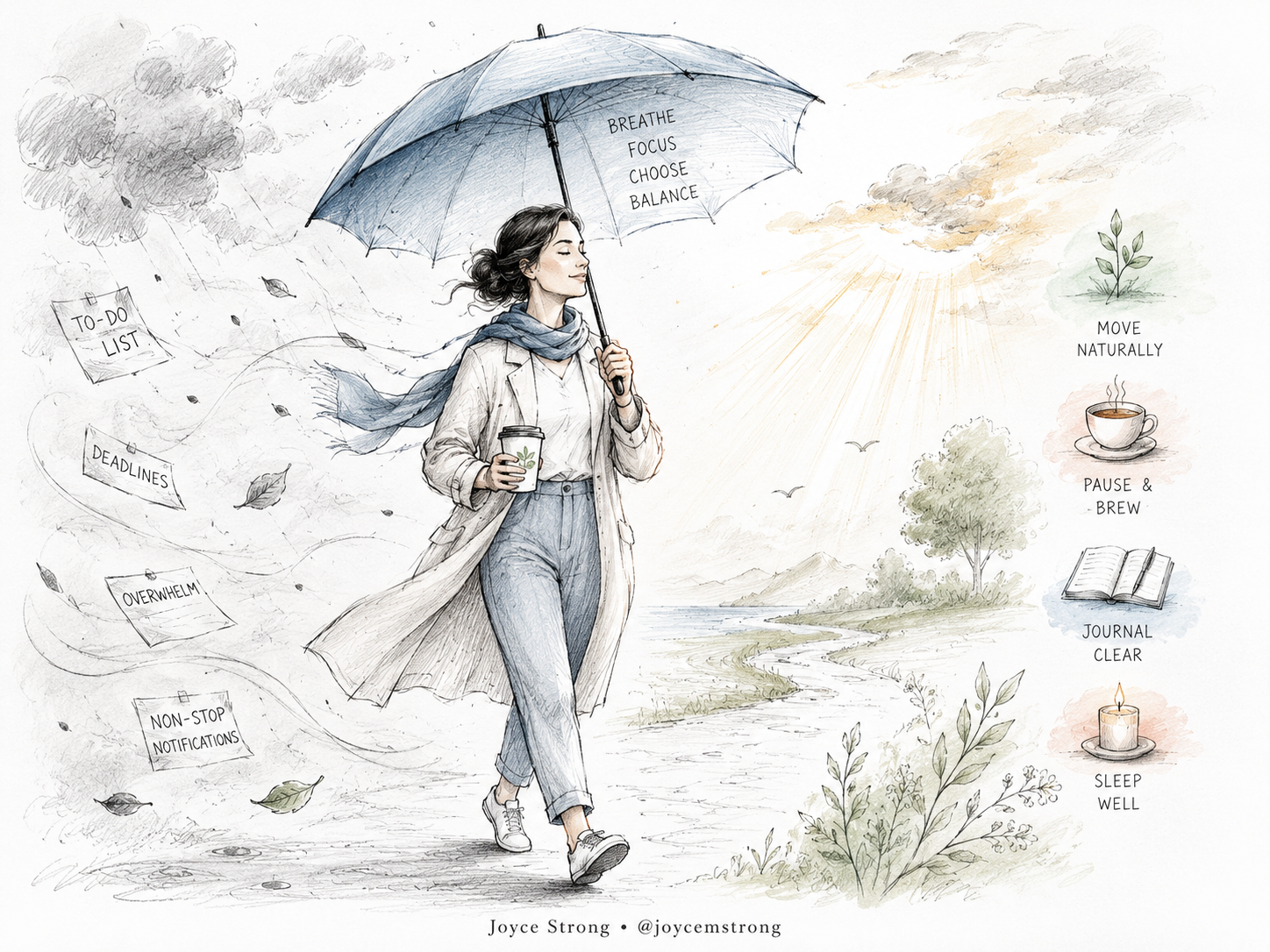
Deadlines. Family obligations. Traffic. Money worries. Work. Health concerns. A constant stream of news and notifications. Some days, your nervous system barely gets a chance to settle before the next demand arrives.
We can’t eliminate stress, and we probably shouldn’t try. Stress is part of being human. In the right amount, it helps us pay attention, respond to danger, meet a deadline, and rise to a challenge.
The problem is stress without enough recovery.
When your body spends too much time on high alert, everything can start to feel harder. You may become more irritable, sleep poorly, lose concentration, reach for comfort foods, or feel exhausted even when you haven’t done anything particularly strenuous.
Resilience isn’t the ability to avoid stress. It’s the ability to respond to stress and then recover from it.
And that is something you can practice.
1. Start With Your Nervous System
Stress isn’t just something happening in your thoughts. It’s a whole-body response.
When your brain detects a threat — whether it’s genuine physical danger, an argument, a frightening headline, or an email you’ve been dreading — your sympathetic nervous system can shift into action. Heart rate increases. Muscles tighten. Breathing may become faster and shallower. Your body prepares to do something.
That reaction is useful when you need it. The trouble begins when the alarm keeps ringing long after the immediate problem has passed.
One simple way to interrupt that cycle is to slow your breathing, particularly your exhale.
Try inhaling gently through your nose for about four counts, pausing briefly if that feels comfortable, and then exhaling slowly for about six counts. Continue for a couple of minutes without forcing the breath.
The goal isn’t to perform the exercise perfectly. It’s simply to give your body a few moments in which nothing is being demanded of it.
Think of it as telling your nervous system, “There is no emergency in this particular moment.”
2. Don’t Give Your Phone the First Word
Many of us begin the day by reaching for a phone before our feet have even touched the floor.
Within minutes, we may be absorbing breaking news, unanswered emails, financial worries, other people’s problems, social media arguments, and a list of things we haven’t accomplished yet.
Your day has barely begun, and your brain is already reacting.
Consider creating a small morning anchor instead.
It doesn’t need to involve an elaborate routine, meditation cushion, journal, smoothie, and sunrise workout. Five or ten minutes is enough.
Stretch while the coffee brews. Step outside and notice the temperature. Sit quietly with your tea. Walk around the block. Write down the three things that actually matter today.
The particular ritual matters less than the message behind it:
I get to enter my day before the rest of the world enters my head.
3. Stop Waiting Until You’re Overwhelmed
Most people try to manage stress after they’ve already reached their limit.
By then, everything feels urgent.
A more effective approach is to build brief recovery periods into an ordinary day — before you desperately need them.
Take a five-minute walk. Stand up and loosen your shoulders after sitting at the computer. Step outside between meetings. Put on a song you love. Drink a glass of water. Look away from a screen and focus your eyes on something in the distance.
These things can seem almost too small to matter.
That’s exactly why they work as habits.
You don’t need an hour-long wellness ritual every time life gets difficult. You need small opportunities throughout the day to interrupt the accumulation of tension.
Think of stress like water slowly filling a bucket. You don’t have to wait until it spills across the floor before emptying some of it.
4. Notice the Story Your Brain Is Telling
Stress comes from circumstances, but it can also be amplified by the story we tell ourselves about those circumstances.
I’m never going to finish this.
Everything is going wrong.
I can’t handle another thing.
What if this turns into a disaster?
The goal isn’t to replace every uncomfortable thought with forced positivity. Sometimes things genuinely are difficult.
Instead, make the thought more accurate and more useful.
Instead of “I’ll never get all of this done,” try:
“I don’t have to solve everything at once. What is the next thing I can do?”
Instead of “This is a disaster,” try:
“This is difficult. What part of it can I control?”
That small shift moves the brain away from helplessness and toward action.
You don’t need to convince yourself that everything is wonderful.
You need to remind yourself that difficult is not the same thing as impossible.
5. Protect the Basics Before Looking for Hacks
We tend to search for sophisticated solutions to stress while overlooking the things our nervous systems depend on every day.
Sleep matters.
Food matters.
Movement matters.
Hydration matters.
Sunlight matters.
Connection with other people matters.
So does pleasure.
A conversation that makes you laugh, twenty minutes in the garden, playing with your dog, reading something you enjoy, listening to music, cooking, walking, or simply sitting somewhere pleasant without accomplishing anything can be part of recovery.
These aren’t indulgences that you earn after becoming productive enough.
They are part of the maintenance required to remain functional.
Your ability to handle tomorrow’s stress is affected by how well you recover from today’s.
6. Make Your World a Little Less Reactive
Sometimes stress management is less about learning to tolerate more and more stimulation and more about reducing unnecessary stimulation in the first place.
Turn off notifications you don’t need.
Stop checking email every five minutes.
Don't automatically say yes to every request.
Create periods when you aren’t consuming news.
Give yourself permission to finish one thing before beginning three others.
And remember that boundaries are a form of stress management too.
You cannot deep-breathe your way out of a life in which everyone else has unlimited access to your time and attention.
7. Build Resilience in Ordinary Moments
Resilience is often imagined as something heroic — the extraordinary person who remains strong during extraordinary circumstances.
Most resilience is built much more quietly.
You build it when you take the walk instead of sitting with the tension.
When you go to bed instead of scrolling for another hour.
When you recognize that your thoughts are spiraling and bring yourself back to what is actually happening.
When you ask for help.
When you say no.
When you rest without feeling that you have to justify it.
When you have a difficult day and begin again tomorrow.
Those small decisions teach your brain and body something important:
Stress can rise. And stress can come back down.
The Bottom Line
You probably can’t truly stress-proof your life.
Life will continue to be unpredictable. People will disappoint you. Plans will change. Bills will arrive. Headlines will be disturbing. Someone will send that email.
But you can become better at moving through those moments without allowing every one of them to take over your entire day.
That’s resilience.
Not becoming someone who never feels stressed, but becoming someone who recognizes stress earlier, responds to it more deliberately, and knows how to recover.
Start small.
Take one slower breath. Put the phone down for ten minutes. Walk around the block. Go to bed a little earlier. Ask yourself what you can control.
Then do it again tomorrow.
Resilience isn’t one big act of strength. It’s a collection of small acts of recovery, practiced over and over until your body begins to remember the way back to steady.