
One Foot on the Gas, One Foot on the Brake
Why wanting to change is not always enough—and what may really be keeping you stuck
You know what you want to change. You may have wanted it for years.
You want to build a life around work you love, take better care of yourself, stop saying yes when you mean no, set a boundary, finish the project, or make room for a relationship that is mutual.
You understand the problem. You may even know what you need to do next.
And yet, you do not do it.
It is tempting to call this procrastination, a lack of motivation, or poor discipline. You tell yourself to try harder, make a better plan, or finally get serious.
But what if you are already trying?
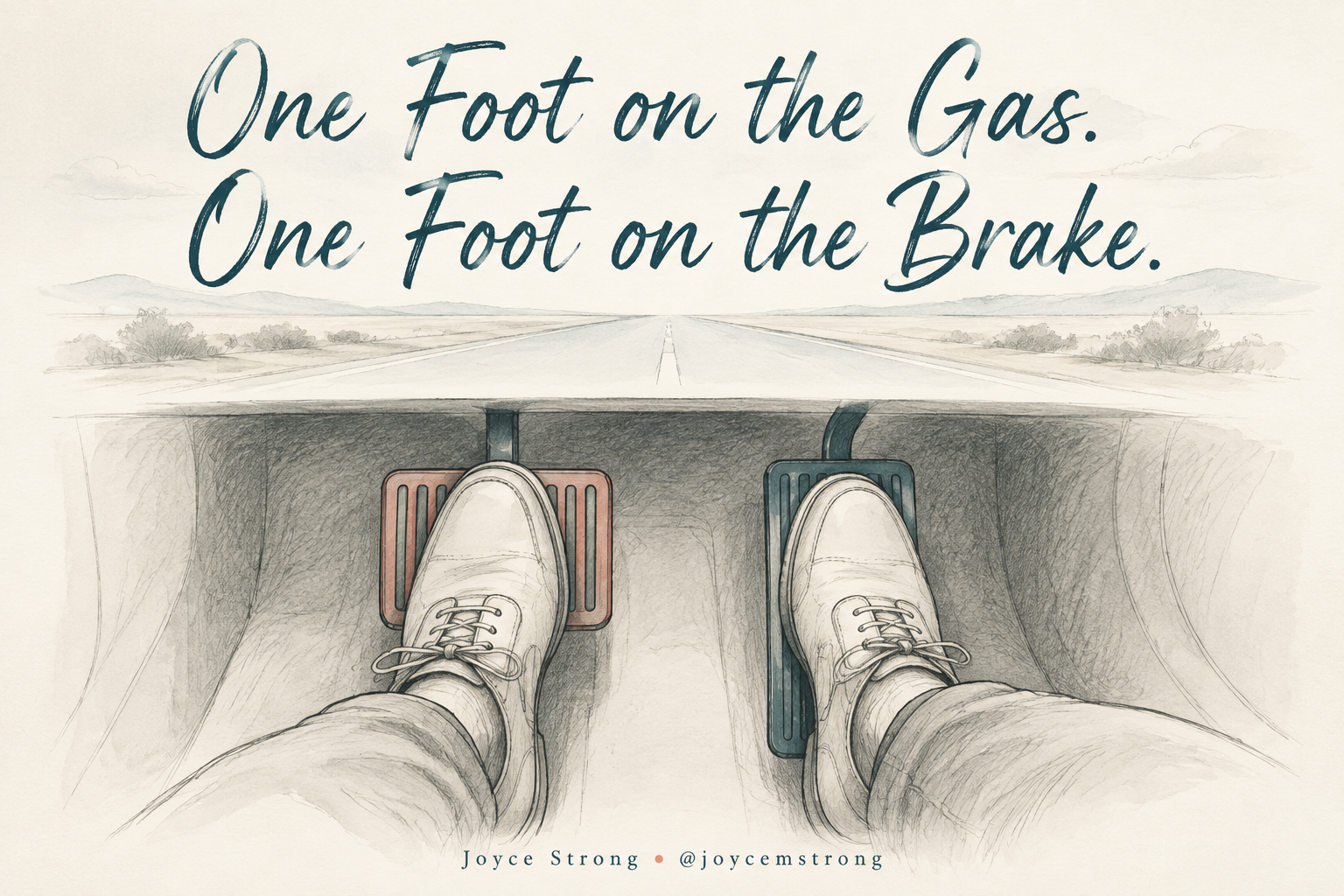
What if you have one foot on the gas and one foot on the brake?
Wanting Change and Resisting It Can Both Be Real
Robert Kegan and Lisa Laskow Lahey use the term immunity to change to explain why a sincere desire for change is not always enough to produce it.
The gas pedal represents the change you genuinely want. The brake represents another commitment, often hidden from you, that is working just as hard to prevent something you fear.
You may want to be paid fairly for your work while also being committed to never appearing greedy or needy. You may want better boundaries while remaining committed to keeping everyone comfortable with you.
You may want to stop rescuing other people while fearing that, if they no longer need you, they may no longer love you.
These hidden commitments do not mean you are weak, dishonest, or unwilling to change. They may have developed when keeping the peace, being useful, staying quiet, or anticipating other people’s needs helped you remain safe or connected.
The strategy may have worked. It may even have helped you survive.
But a strategy that once protected you can eventually become a cage.
Why Pushing Harder May Not Work
When we feel stuck, we usually press harder on the gas. We make stricter plans, set larger goals, and criticize ourselves for failing to follow through.
When that does not work, we assume we need even more discipline.
But pressing harder on the gas while the brake remains engaged creates friction. It consumes energy without producing meaningful movement.
The way forward is not to declare war on yourself. It is to understand what the brake is trying to prevent.
Kegan and Lahey’s immunity-to-change map offers a practical way to uncover that conflict.
Column One: What Do I Genuinely Want to Change?
Begin with something specific and meaningful.
“I want to build a sustainable life around work I love.”
“I want to stop saying yes when I mean no.”
“I want to make my health a priority.”
“I want to make room for a relationship that is mutual.”
This is not a goal someone else assigned to you. It is a change you genuinely want and believe would improve your life.
Column Two: What Am I Doing—or Not Doing—That Works Against That Goal?
This is where you tell the truth without calling yourself names.
Perhaps you want to build a sustainable life around meaningful work, but you continue giving your work away. You avoid asking to be paid fairly, spend your best hours on work that cannot support you, and wait for people to recognize your value without telling them what you offer.
Perhaps you want better boundaries, but you answer every message immediately. You explain your decisions until everyone agrees with you and soften every no until it sounds like a maybe.
Perhaps you want to improve your health, but you repeatedly place your own needs at the bottom of the list. You wait for a time when nobody needs anything from you, although that time never arrives.
The purpose of this column is not to build a case against yourself. It is to identify the behaviors that keep the current system in place.
Column Three: What Am I Afraid Will Happen?
Now imagine doing the opposite of what you listed in Column Two.
If you asked to be paid fairly, what are you afraid might happen?
If you said no without offering a lengthy explanation, what do you fear the other person would think or do?
If you stopped solving everyone else’s problems, what would that mean about your role in their lives?
Your answers may reveal fears such as:
“If I ask for money, people will think I am greedy.”
“If someone is angry with me, I must have done something wrong.”
“If I stop being useful, I will no longer be needed.”
“If I finish this project, other people can judge it.”
Beneath each fear is a hidden commitment:
“I am committed to never being seen as greedy.”
“I am committed to preventing other people from being disappointed in me.”
“I am committed to being needed.”
“I am committed to avoiding the possibility of failure.”
The hidden commitment explains why the brake remains engaged. You are not merely failing to move toward your goal; you are also succeeding at protecting yourself from something you fear.
Column Four: What Is the Big Assumption?
The final column identifies the belief that makes the hidden commitment feel necessary.
“If I ask to be paid fairly, people will leave.”
“If someone is angry with me, I have done something wrong.”
“If I am not useful, I will not be loved.”
“If I try something new and it does not work, I will have proved that I am a failure.”
These assumptions can feel like facts because they may have been formed through painful experience. But an assumption is not necessarily a permanent truth.
The question is not whether it was ever true. The question is whether it remains true now, in every situation, with every person.
Test the Assumption Gently
You do not have to challenge a deeply rooted belief with one dramatic leap. You can design a small, reasonably safe experiment and gather new evidence.
Ask one person to support your work and observe what happens.
Say one clear no without a ten-paragraph explanation and see whether the relationship survives.
Allow someone to solve one of their own problems and notice whether you still matter to them.
Share a small piece of unfinished work with someone you trust and see whether imperfection leads to rejection.
The purpose is not to guarantee that nobody will become angry, leave, or disappoint you. Some people may react badly when you change a pattern that benefited them.
The purpose is to discover whether the feared outcome is inevitable—and whether protecting yourself from it is still worth the life you are giving up.
You Are Not Broken
We can want freedom and fear uncertainty. We can want to be seen and fear being judged. We can want support and struggle to trust it.
Both feet are trying to help, although they are working in opposite directions.
Lasting change becomes more possible when you stop asking, “What is wrong with me?” and begin asking, “What am I protecting myself from?”
Find the belief beneath the behavior. Identify the hidden commitment that keeps the brake engaged, and test the assumption carefully enough to gather new evidence.
You may discover that the strategy protecting you was built for a life you no longer live.
You do not need to bulldoze yourself into change. You need to understand what has been stopping you so that both feet can finally work in the same direction.